
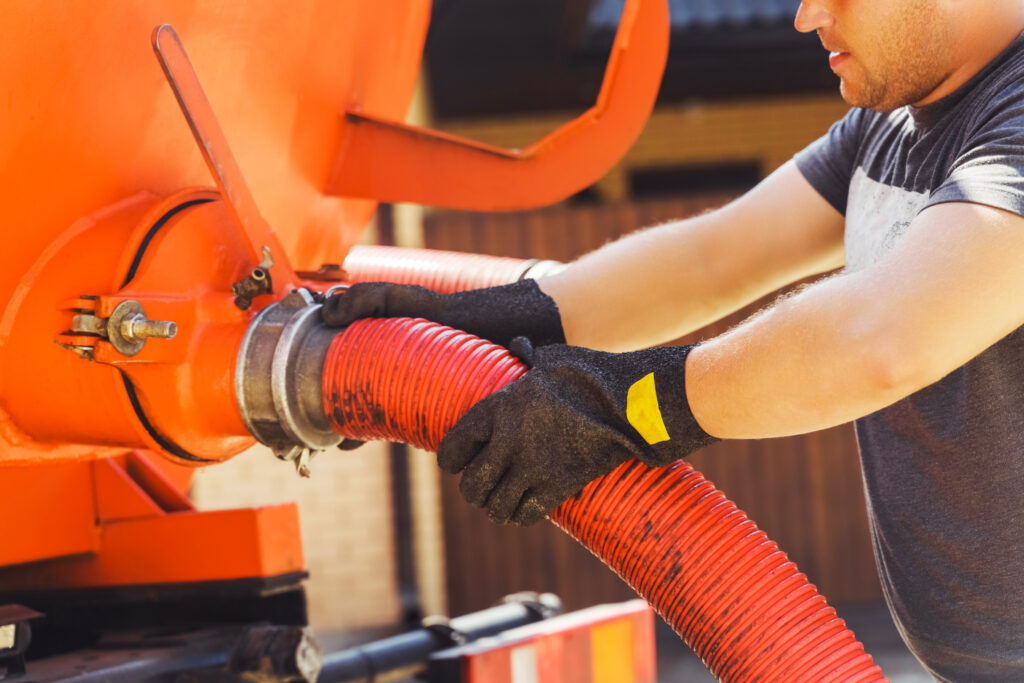
Concrete pumping is one of the most demanding applications a hose can face. Abrasive aggregate, high pressure, repeated flexing, and the unforgiving pace of a construction site all combine to put serious stress on hose assemblies. When a concrete hose fails mid-pour, the consequences go beyond equipment damage — delays, wasted material, and project setbacks add up fast.
At ASJ Industrial Hose & Fittings, we supply the construction industry with hoses and fittings built to hold up under these conditions. Here’s what contractors need to understand before selecting and using concrete pumping hoses on their next project.
What Makes Concrete Pumping So Demanding
Concrete isn’t a simple liquid. It’s a thick, abrasive slurry of cement, aggregate, sand, and water that moves through hose assemblies under substantial pressure. The aggregate particles are constantly abrading the interior hose wall with every pump stroke. At the same time, the hose must flex with the movement of the pump boom or the positioning needs of the crew on the ground.
This combination of internal abrasion, pressure, and flexing creates a wear profile unlike most other industrial hose applications. A hose that isn’t specifically engineered for concrete pumping will wear through quickly — and often without obvious external warning signs until failure occurs.
Key Specifications to Evaluate
When selecting a concrete pumping hose, several specifications deserve close attention.
Wall Thickness and Tube Material
The inner tube takes the brunt of abrasion from moving concrete. Thicker walls extend service life, but the material matters just as much as the thickness. High-quality concrete hoses use wear-resistant rubber compounds specifically formulated to withstand the constant abrasion of aggregate. Cutting corners on tube quality is a false economy — a thinner or lower-grade liner will wear through far sooner and ultimately cost more in replacements and downtime.
Pressure Rating
Concrete pumping generates significant pressure, and that pressure can spike when blockages occur or the pump operator adjusts flow. Your hose must be rated well above your standard operating pressure to accommodate these spikes safely. Always work with a supplier who can help you match the hose pressure rating to your specific pump and application.
Hose Diameter
Diameter affects both flow rate and the aggregate size the hose can handle. Using an undersized hose restricts flow, increases pressure, and accelerates wear. Matching hose diameter to your pump specifications and the mix design you’re working with is an important step that shouldn’t be skipped.
End Fittings and Couplings
Concrete hose couplings endure the same abuse as the hose itself. Fittings need to be robust, properly matched to the hose, and compatible with your pump and boom connections. Loose or mismatched couplings are a common cause of failures and leaks at the connection points.
Inspection and Retirement
Concrete hoses don’t last forever, and knowing when to retire a hose before it fails is critical on a busy job site. Regular inspection should include checking the outer cover for cuts, abrasion, and bulging — a bulge indicates inner liner damage and is a sign the hose should be pulled from service immediately. Hose wall thickness can be monitored over time using ultrasonic testing tools that measure wear without cutting the hose open.
Establish a retirement schedule based on manufacturer guidelines and your actual operating conditions, and stick to it. An unexpected hose failure during a pour is never worth the cost savings of running a hose past its useful life.
Get the Right Hose Before the Job Starts
At ASJ Industrial Hose & Fittings, we carry concrete pumping hoses and fittings suited to the demands of commercial and residential construction. Our experienced team can help you match the right hose to your pump, your mix, and your project requirements. With extensive on-site inventory at our Corona, CA location, many orders are ready for immediate will-call pickup or fast shipment anywhere in North America.
Call us at (951) 735-1351 before your next pour and we’ll make sure you have the right equipment to get the job done.

 Phone: