
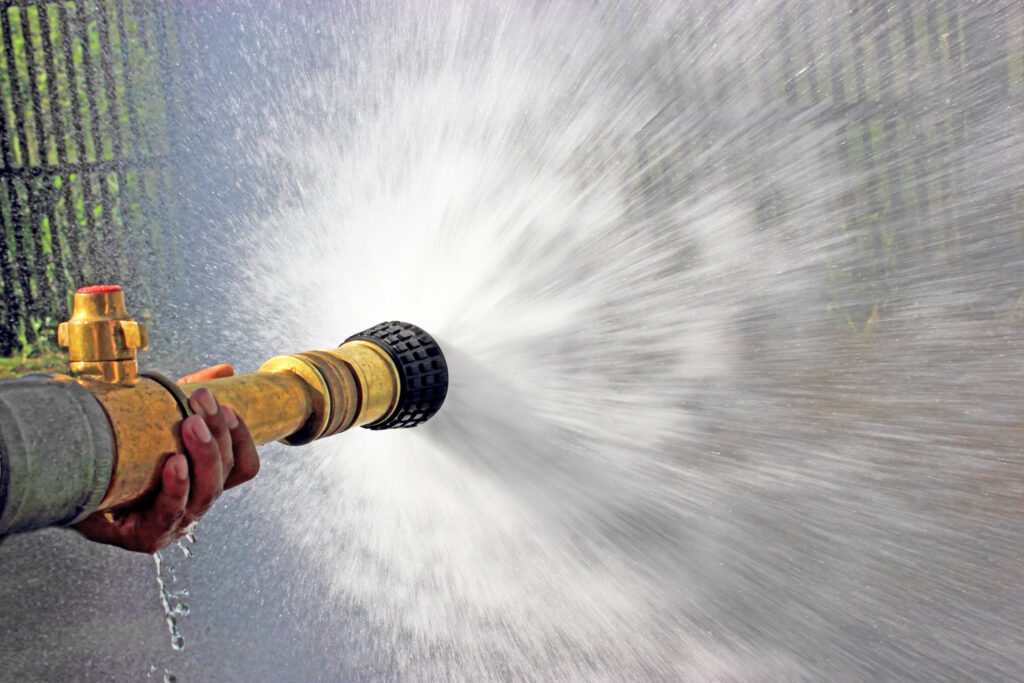
A fire hose is only as reliable as the accessories connected to it. Nozzles, couplings, and racks all play a critical role in whether a fire suppression system performs the way it’s supposed to when it counts. For contractors and facility managers responsible for installing or maintaining these systems, understanding how each component contributes to compliance and performance is just as important as choosing the hose itself. At ASJ Industrial Hose & Fittings, we help customers source complete fire supply solutions that meet relevant safety and building code standards.
Why Nozzles Matter More Than You Think
The nozzle determines how water is delivered at the point of use, and choosing the wrong one can compromise both safety and effectiveness. Different applications call for different flow patterns and control features.
- Adjustable-pattern nozzles allow users to switch between a straight stream and a fog pattern depending on the situation
- Shut-off nozzles give operators control over water flow without needing to close a valve elsewhere in the system
- Flow rate and pressure ratings must match the rest of the system to avoid under- or over-delivery
Selecting a nozzle without considering the full system can create bottlenecks or pressure imbalances that reduce overall performance.
Couplings: The Connection Point That Can’t Fail
Hose couplings join sections of fire hose together or connect hose to standpipes, hydrants, and other fixed points. Because these connections see repeated use, often under emergency conditions, they need to be dependable every time.
- Threaded couplings remain the most common choice for standard fire hose applications
- Storz-style couplings offer quick, tool-free connections favored by many fire departments
- Compatibility between coupling types across a building or campus prevents delays during an actual emergency
Building codes often specify which coupling types are acceptable for a given occupancy or jurisdiction, so it’s worth confirming local requirements before finalizing a system design.
Racks and Reels: Keeping Hose Ready for Immediate Use
A fire hose stored improperly can develop kinks, abrasion damage, or simply become difficult to deploy quickly. Racks and reels are designed to solve that problem.
- Pin racks hold hose in a folded configuration that allows for rapid unrolling
- Horizontal and vertical rack styles suit different cabinet and wall-mounting configurations
- Reels are often preferred in industrial settings where hose needs to be extended and retracted regularly, not just during emergencies
The right storage solution depends on the layout of the space, how frequently the hose will be accessed, and applicable code requirements for hose cabinet placement and visibility.
Building a System That Works Together
None of these components function in isolation. A high-quality nozzle paired with mismatched couplings, or a reliable coupling connected to a rack that doesn’t allow for smooth deployment, can undermine the performance of the entire system. That’s why it pays to work with a supplier who understands how all the pieces fit together, not just individual products.
Specialty Items and Graphics
Beyond the core components, many fire supply systems also require specialty items and signage or graphics to meet code requirements for visibility and identification. These details are easy to overlook but are often required for inspection sign-off.
Sourcing Fire Supply Products That Meet Code
Whether you’re outfitting a new commercial building or updating an existing fire suppression system, having access to a full range of compliant fire supply products in one place simplifies the process. At ASJ Industrial Hose & Fittings, our extensive on-site inventory means many items are available for immediate pickup or fast shipment, so your project doesn’t get held up waiting on parts.
Our team has decades of experience helping contractors and facility managers select the right combination of nozzles, couplings, racks, and other fire supply accessories for their specific application. If you have questions about what your system needs to stay compliant, call us at (951) 735-1351 and we’ll help you get it right the first time.

 Phone: