
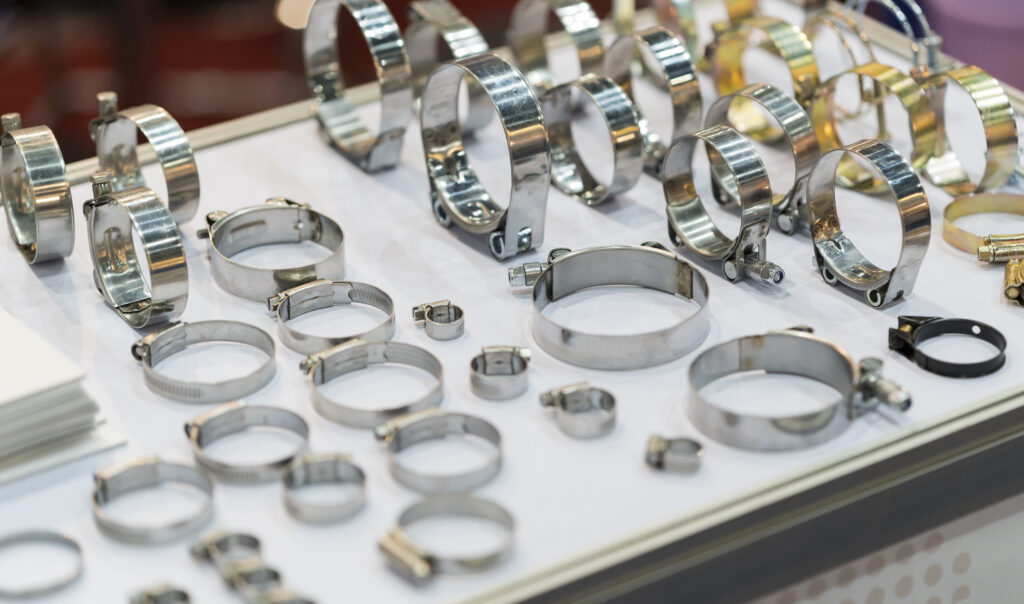
A hose clamp might be the smallest component in your fluid system, but it’s doing one of the most important jobs. A clamp that’s wrong for the application — whether it’s undersized, made from the wrong material, or the wrong design entirely — can allow leaks, damage the hose, or fail under pressure at exactly the wrong moment. Understanding the differences between clamp types helps you make the right call before a problem develops.
Worm Gear Clamps
Worm gear clamps are the most widely recognized clamp design and for good reason — they’re versatile, adjustable, and easy to install with a standard screwdriver or nut driver. A slotted band is tightened by turning a screw mechanism, drawing the band evenly around the hose.
They work well across a broad range of hose diameters and are a common choice for water, air, and light-duty fluid applications. For higher-pressure systems or applications requiring a more uniform clamping force, other designs may be more appropriate.
Center Punch Clamps
Center punch clamps use a series of indentations punched into the band to create a strong, consistent grip. They’re a reliable choice for applications where vibration is a factor, as the design resists loosening over time better than some other options. Center punch clamps are frequently used in automotive and industrial settings where durability under dynamic conditions is a priority.
Stainless Steel Clamps
Material matters as much as design. In environments involving moisture, chemicals, salt air, or extreme temperatures, a standard carbon steel clamp will corrode — and a corroded clamp is a compromised clamp. Stainless steel clamps offer significantly better corrosion resistance and are the right choice for outdoor installations, marine applications, chemical handling, and food and beverage processing where hygiene and durability are both concerns.
At ASJ Industrial Hose & Fittings, we carry stainless steel options across multiple clamp styles so you don’t have to sacrifice design for material quality.
Strapping and Band Clamps
For larger diameter hoses or applications where a wide clamping surface is needed to distribute load evenly, strapping and band-style clamps are often the better solution. The wider contact area reduces the risk of cutting into softer hose materials and provides a more stable seal across the connection. These are commonly used in industrial ducting, large-diameter water lines, and heavy equipment applications.
Clamping Tools
Having the right clamp is only half the equation — proper installation matters just as much. Under-tightened clamps leak. Over-tightened clamps can damage the hose wall or distort the fitting, creating a failure point rather than preventing one. ASJ Industrial Hose & Fittings stocks clamping tools designed to help technicians achieve consistent, correct torque during installation, reducing the risk of field failures caused by improper technique.
Size and Specification
Regardless of clamp type, sizing must be matched to the hose and fitting combination you’re working with. A clamp that’s too large won’t generate adequate clamping force. One that’s too small may not close fully or could damage the hose. Always verify the hose’s outer diameter and select a clamp rated for that range.
Find the Right Clamp at ASJ Industrial Hose & Fittings
With decades of experience supplying hose assemblies and accessories to the construction, oil and gas, chemical, and food and beverage industries, ASJ Industrial Hose & Fittings carries just about any size, strength, material, and design of clamp you could need. Our staff can help you work through the specs and get the right product the first time. Call ASJ Industrial Hose & Fittings today at (951) 735-1351 to discuss your application.
 Phone: