
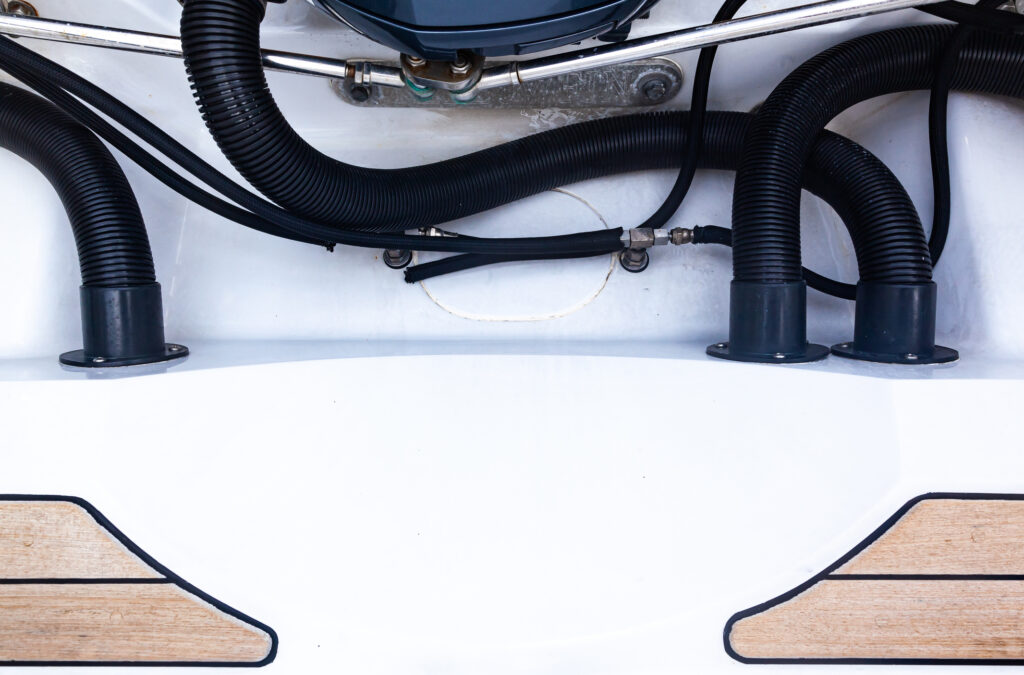
Marine exhaust systems operate in one of the most demanding environments any hose will ever face. Heat, moisture, exhaust gases, constant vibration, and saltwater exposure combine to create conditions that will quickly expose any weakness in an undersized or poorly specified hose. For boat builders, marine mechanics, and refit professionals, understanding what makes a marine exhaust hose different from standard hose products is essential to building systems that hold up over time.
Why Marine Exhaust Is a Unique Application
On most vessels, the exhaust system uses a wet exhaust configuration — raw cooling water is injected into the exhaust stream to cool the gases before they travel through the hose and exit the boat. This means the hose must handle both elevated temperatures from the exhaust and continuous water exposure simultaneously, while also resisting the corrosive effects of exhaust gases themselves.
Dry exhaust systems, found on some commercial and high-performance vessels, skip the water injection entirely and run significantly hotter. Hose selection for dry exhaust applications demands even more careful attention to temperature ratings.
Temperature Ratings and Heat Resistance
Temperature rating is the first specification to verify when selecting a marine exhaust hose. The hose must be rated to handle the maximum exhaust temperatures your engine produces, with appropriate margin for heat spikes during hard running. Using a hose that isn’t rated for your engine’s exhaust temperatures will cause the hose to degrade from the inside, leading to premature failure — often in a location that’s difficult to access for emergency repairs.
At ASJ Industrial Hose & Fittings, our team can help you identify hose options with the temperature ratings appropriate for your specific engine and exhaust configuration.
Reinforcement and Wall Construction
Marine exhaust hoses are typically built with multiple layers — an inner liner resistant to heat and exhaust gases, reinforcement layers for structural integrity and pressure resistance, and an outer cover that resists moisture, abrasion, and UV exposure. The quality and construction of these layers determine how well the hose holds up under the combined stresses of a marine exhaust environment.
Thin-walled or lightly reinforced hoses that might perform adequately in less demanding applications will not provide the service life expected in marine exhaust use.
Flexibility and Routing
Engine compartments on boats are rarely generous with space. A marine exhaust hose needs to be flexible enough to route through tight bends and around obstructions without kinking or collapsing the interior bore. Kinking restricts flow, creates back pressure on the engine, and concentrates stress at the bend point — all conditions that accelerate failure.
When planning an exhaust hose run, minimize sharp bends where possible and select a hose with the flexibility characteristics to handle the routing your installation requires.
Clamping and Connections
In a saltwater environment, the clamps and fittings securing your exhaust hose are just as vulnerable as the hose itself. Stainless steel clamps are the standard choice for marine applications, offering the corrosion resistance needed to survive years of saltwater exposure without degrading. Using standard carbon steel hardware in a marine environment is a maintenance problem waiting to happen.
ASJ Industrial Hose & Fittings stocks stainless steel clamps and marine-appropriate fittings to complement any hose assembly, so you can source everything you need in one place.
Source Your Marine Exhaust Hose from ASJ Industrial Hose & Fittings
With over 35 years of experience supplying hoses, fittings, and accessories across a wide range of demanding industries, ASJ Industrial Hose & Fittings has the product knowledge to help you get marine exhaust hose selection right. Call ASJ Industrial Hose & Fittings today at (951) 735-1351 and let our team help you find the right hose for your vessel and application.


 Phone: