
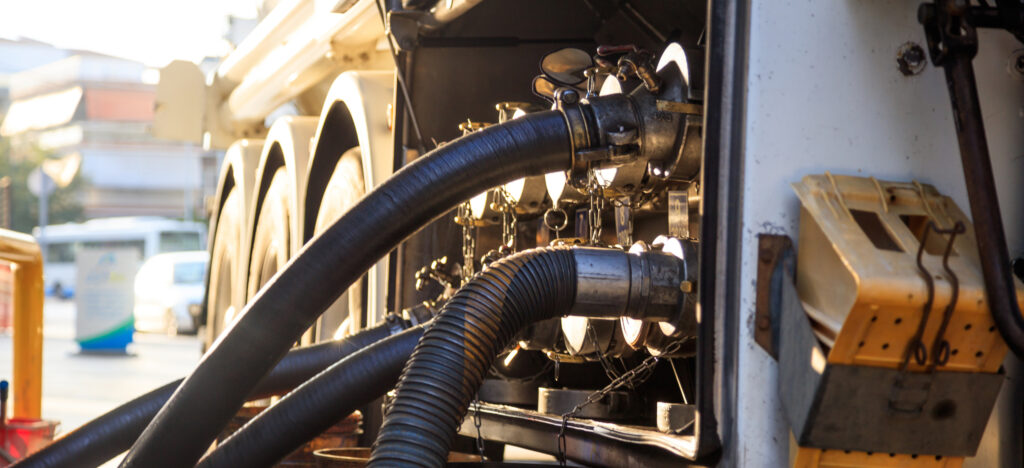
Petroleum transfer is one of the most demanding hose applications in any industry. The media is aggressive, the pressures are significant, and the consequences of a failure can range from costly downtime to serious environmental and safety incidents. Selecting the right hose for oil and petroleum applications isn’t a decision to make based on price alone — it requires understanding what the application actually demands and what the hose must deliver.
The Core Challenge: Chemical Compatibility
Petroleum products — crude oil, refined fuels, lubricants, and petroleum-based chemicals — are aggressive toward many rubber compounds. A hose with an inner tube that isn’t specifically designed for petroleum service will swell, soften, and degrade from the inside. This leads to contamination of the transferred product, loss of hose integrity, and eventual failure at the worst possible time.
The inner tube of a petroleum transfer hose must be formulated to resist swelling and degradation when in continuous contact with hydrocarbon-based media. Nitrile rubber is one of the most widely used materials for this purpose, offering strong resistance to oils, fuels, and petroleum products across a broad temperature range.
At ASJ Industrial Hose & Fittings, we carry petroleum hoses built for real-world oil and gas applications, and our team can help match the right product to your specific media and operating conditions.
Pressure and Suction Requirements
Oil and gas operations involve both pressure and suction applications. Delivery hoses need to handle the working pressure of the pump and withstand pressure spikes without compromising the hose wall or fittings. Suction hoses require a reinforced construction that prevents the hose from collapsing under vacuum, which would restrict or stop flow entirely.
Many petroleum transfer hoses are designed for combined pressure and suction service, but it’s important to confirm that any hose you’re considering is rated for the specific demands of your setup. Using a pressure-only hose in a suction application is a common and costly mistake.
Static Dissipation in Petroleum Hose Systems
The flow of petroleum products through a hose generates static electricity. In a system that isn’t properly grounded or that uses a hose without static-dissipative properties, static buildup can create a spark risk — a serious concern in any environment where flammable vapors may be present.
Petroleum transfer hoses used in fuel delivery, tank filling, and similar applications should include a static wire or be constructed with a conductive or static-dissipative inner tube. Proper grounding of the hose assembly and the equipment it connects to is equally important.
This is one area where cutting corners on hose specification creates risks that go well beyond equipment damage.
Fittings and Couplings Matter as Much as the Hose
A petroleum hose is only as reliable as the fittings attached to it. Couplings must be compatible with the hose construction, properly crimped or attached, and rated for the same pressure and temperature conditions as the hose itself.
Cam and groove fittings are widely used in petroleum transfer for their fast connection speed and reliable sealing. The material selection for fittings in petroleum service should account for the specific products being transferred — aluminum is common for many fuel applications, while stainless steel may be required in more aggressive environments.
Get the Right Petroleum Hose from ASJ Industrial Hose & Fittings
ASJ Industrial Hose & Fittings has been supplying hoses and fittings to the oil and gas industry and other demanding industrial sectors since 1982. We stock petroleum transfer hoses, suction and discharge hoses, and the fittings to go with them. Call (951) 735-1351 or stop by our Corona, CA location and let our experienced team help you find exactly what your application requires.


 Phone: